


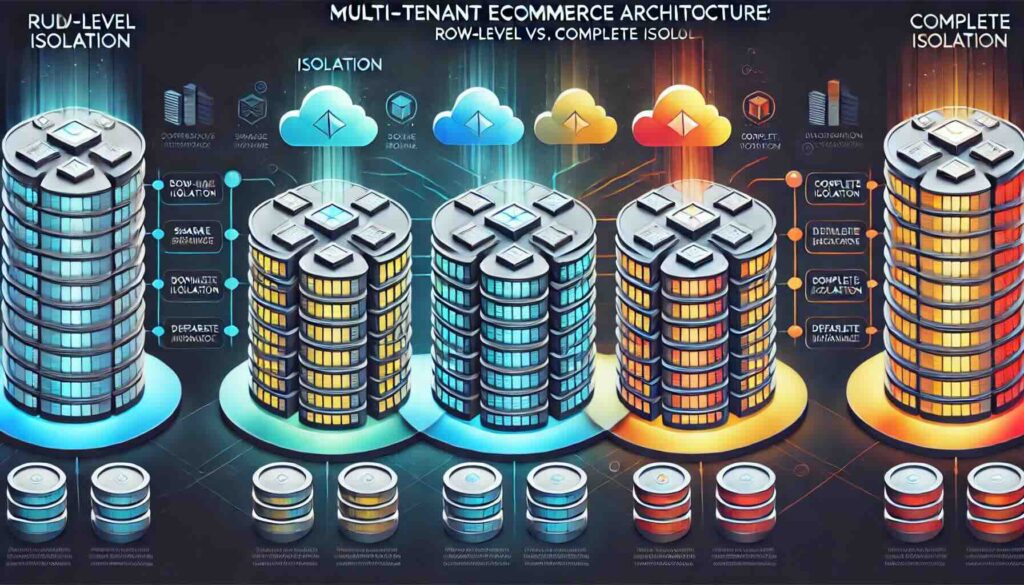
Multi-tenant eCommerce Architecture: Choosing Between Row-Level and Complete Isolation
When building a multi-tenant eCommerce platform, one of the most crucial architectural decisions is how to handle data isolation between tenants. Spree Commerce offers flexibility in this regard, supporting both complete tenant isolation for regulated industries and contractual obligations, as well as row-level tenancy for scenarios where sharing infrastructure makes more sense.

Key Takeaways
Two multi-tenant eCommerce architectures sit at opposite ends of the isolation spectrum: row-level tenancy (shared database, tenant_id column, PostgreSQL Row Level Security) and complete isolation (one dedicated database per tenant). Spree Commerce supports both, so the right choice depends on cost targets, regulatory posture, and scale.
Who this is for: Platform architects, CTOs, and engineering leads building white-label, SaaS, or multi-brand eCommerce platforms who need to pick a tenant isolation model before committing to infrastructure.
What you get: A side-by-side comparison of row-level tenancy and complete isolation, use-case patterns (manufacturing B2B, health practitioners, healthcare equipment, government, financial services), implementation considerations, and the best practices that apply to both.
Why it matters: The isolation model sets the unit economics of a white-label or SaaS eCommerce business. Row-level shares infrastructure and scales cheaply; complete isolation satisfies strict regulations but costs more per tenant. Picking the wrong model creates operational drag that compounds with every new tenant.
Last verified: April 2026.
The choice between these approaches can significantly impact your system’s scalability, maintenance, and compliance capabilities.
Understanding Multi-tenancy Approaches
Row-Level Tenancy
Row-level tenancy, also known as shared schema multi-tenancy, stores data from multiple tenants in the same database tables. Each row includes a tenant identifier column that determines ownership and access rights.
How It Works
- All tenants share the same database and schema
- Each database record includes a tenant_id column
- PostgreSQL’s Row Level Security (RLS) policies enforce data isolation
- Database queries automatically filter results by tenant
Advantages
Resource Efficiency
- Shared infrastructure reduces hosting costs
- Simplified backup and maintenance procedures
- Easier database optimization across all tenants
Simplified Development
- Single codebase maintenance
- Consistent schema across all tenants
- Easier implementation of cross-tenant features
Scalability
- More efficient use of database connections
- Simplified deployment process
- Easier horizontal scaling
Potential Concerns
- Requires careful implementation of security policies
- May not meet strict regulatory requirements
- Slightly more complex query planning
Complete Tenant Isolation
This approach maintains separate databases for each tenant, providing maximum isolation and independence.
How It Works
- Each tenant gets their own dedicated database
- Complete separation of data and schema
- No shared infrastructure at the database level
- Independent backup and maintenance possibilities
Advantages
Maximum Security
- Physical data separation
- No risk of data leakage between tenants
- Easier compliance with strict regulations
Tenant Independence
- Custom schemas per tenant if needed
- Independent scaling and maintenance
- Simplified compliance auditing
Performance Isolation
- No resource competition between tenants
- Easier performance troubleshooting
- Independent backup and restore operations
Potential Concerns
- Higher infrastructure costs
- More complex deployment procedures
- Increased maintenance overhead
Choosing the Right Approach
The decision between row-level tenancy and complete isolation should be based on several factors:
Consider Row-Level Tenancy When:
- Cost efficiency is a priority
- Regulatory requirements are standard
- Rapid scaling is needed
- Maintenance simplicity is important
- Cross-tenant features are required
Choose Complete Isolation When:
- Working in heavily regulated industries
- Contractual obligations require physical separation
- Tenants need custom database schemas
- Performance isolation is critical
- Compliance auditing must be simplified
Real-World Use Cases
Row-Level Tenancy Success Cases
- Manufacturing B2B Platform
- Manufacturer providing an eCommerce platform for authorized resellers
- Shared product catalog with reseller-specific pricing
- Centralized inventory management
- Custom catalogs and pricing tiers per reseller
- Unified order processing and fulfillment
- Example: Industrial equipment manufacturer enabling online ordering for their distributor network
- Health Practitioner White-Label eCommerce Platform
- Doctors offering dietary supplements and OTC products to their patients
- Each practice maintains its own branded storefront
- Shared product database with practitioner-specific recommendations
- Unified inventory and fulfillment
- Personalized patient experience under each doctor’s brand
- Example: Nutritionists and physicians selling supplements through personalized online stores
- Professional Product Recommendation Platform
- Service professionals offering curated product selections to their clients
- Individual branded storefronts for each professional
- Shared product database and inventory management
- Professional-specific pricing and recommendations
- Customized content and branding per storefront
Example service professionals that fit this model:
- Hair stylists recommending hair care products
- Personal trainers selling fitness equipment
- Skincare specialists offering beauty products
- Interior designers providing home decor items
Complete Isolation Ideal Scenarios
- Healthcare Equipment Suppliers
- Strict HIPAA compliance requirements
- Complete separation of patient/customer data
- Custom catalog requirements per healthcare institution
- Specific audit trail needs
- Example: Medical supply companies serving different hospital networks
- Government Contractors
- Different security clearance levels
- Strict data sovereignty requirements
- Custom workflows per agency
- Independent audit requirements
- Example: IT equipment suppliers for different government departments
- Financial Services Providers
- Banking regulations requiring data separation
- Different compliance requirements per region
- Custom pricing and product rules
- Independent security protocols
- Example: Investment product platforms serving different financial institutions
Implementation Considerations
For Row-Level Tenancy
- Implement capable testing for tenant data isolation
- Use database constraints to prevent data leakage
- Maintain clear audit logs for all cross-tenant operations
- Regular security audits of RLS policies
For Complete Isolation
- Automate database provisioning for new tenants
- Implement capable backup strategies per tenant
- Plan for efficient resource allocation
- Consider maintenance windows per tenant
Best Practices for Both Approaches
- Security First
- Regular security audits
- complete access logging
- Clear data ownership policies
- Performance Monitoring
- Per-tenant usage metrics
- Resource use tracking
- Performance benchmarking
- Scalability Planning
- Clear tenant onboarding procedures
- Resource allocation strategies
- Growth monitoring and planning
Conclusion
The choice between row-level tenancy and complete isolation isn’t one-size-fits-all. Spree Commerce’s support for both approaches allows businesses to implement the most appropriate solution for their specific needs. Whether you require the efficiency and simplicity of row-level tenancy or the strict isolation of separate databases, the key is aligning your architectural choice with your business requirements, regulatory obligations, and operational goals.
The right solution ultimately depends on your specific use case. Consider your security requirements, regulatory environment, scalability needs, and maintenance capabilities when making this important architectural decision.
Get Started with Spree Commerce
Spree Commerce supports both row-level and complete-isolation multi-tenant architectures so platform operators can match the right model to each tenant’s regulatory and operational profile. Read the multi-tenant eCommerce model documentation to see how tenant isolation, super-admin governance, and per-tenant configuration work together.
For a white-label or SaaS commerce build, two companion posts cover the operating model and the numbers. White-Label Multi-tenant eCommerce With Spree Commerce: Fast Launch for SaaS-Like Solutions walks through the ten-point operating model. How to Build a Multi-Tenant eCommerce Platform covers architecture, features, and costs.
Ready to evaluate Spree Commerce for a multi-tenant build? Head to /get-started/ and our team will help scope the architecture, tenant isolation model, and deployment plan that fits your platform.
Frequently Asked Questions
What is the difference between row-level multi-tenancy and complete tenant isolation?
Row-level multi-tenancy stores every tenant’s records in shared database tables with a tenant_id column on each row and uses PostgreSQL Row Level Security policies to enforce data isolation. Complete isolation gives each tenant a dedicated database with no shared infrastructure at the database layer. Spree Commerce supports both patterns in its multi-tenant module, so platform operators can pick the model that fits cost, compliance, and scaling targets.
When is row-level multi-tenancy the right choice for an eCommerce platform?
Row-level multi-tenancy fits when cost efficiency is a priority, regulatory requirements are standard, rapid tenant scaling is needed, and cross-tenant features like shared catalogs, unified inventory, and central fulfillment are useful. Spree Commerce delivers row-level tenancy on one codebase and one database across every tenant, and enforces isolation through tenant_id filtering and PostgreSQL Row Level Security policies.
When should I choose complete tenant isolation instead?
Complete tenant isolation fits heavily regulated industries (healthcare, government, financial services), contractual obligations that require physical data separation, custom per-tenant database schemas, and hard performance isolation between tenants. Spree Commerce provisions each tenant its own database under the complete isolation model, with independent backup, restore, and maintenance windows that simplify compliance audits and prevent resource competition between tenants.
How does row-level tenancy enforce data isolation between tenants?
Row-level tenancy uses three mechanisms working together: a tenant_id column on every tenant-owned record, PostgreSQL Row Level Security policies that filter queries by the current tenant context, and application-level checks that prevent cross-tenant leakage. Spree Commerce enforces tenant_id filtering and Row Level Security policies across its commerce schema so orders, customers, products, and inventory are isolated by tenant automatically on every query.
Can a multi-tenant architecture meet HIPAA, banking, or government data sovereignty requirements?
Complete tenant isolation is the model that satisfies HIPAA, banking regulations, and data sovereignty rules that require physical data separation. Each tenant runs on its own database with independent backups, audit trails, and access controls. Spree Commerce ships dedicated-database isolation in its multi-tenant module, so healthcare equipment suppliers, government contractors, and financial services providers can run regulated tenants on separate databases inside a single super-admin governance layer.
What are the cost implications of row-level versus complete tenant isolation?
Row-level tenancy is cheaper per tenant because hosting, database, and maintenance resources are shared across every tenant on the platform. Complete isolation costs more because every tenant requires its own database, its own backup schedule, and its own deployment and maintenance overhead. Spree Commerce runs on any hosting provider the platform operator chooses, so the cost trade-off tracks infrastructure and operations decisions rather than platform licensing.